Imagine a child arriving at school with an empty stomach. The classroom may have books, teachers, and opportunities, but hunger can make it difficult to concentrate, participate, or even stay awake. This is why understanding the midday meal importance for children is essential when discussing education, health, and social development.
A nutritious school meal is much more than food on a plate. It can provide children with essential nutrients, support healthy growth, encourage school attendance, and help them participate more actively in learning. In places such as Vijayawada and across Andhra Pradesh, initiatives that address hunger and child nutrition can make a meaningful difference in the lives of children from economically disadvantaged families.
For organisations such as Aashritha Charitable Trust, food distribution and child welfare are part of a broader effort to support vulnerable communities. Aashritha works in Vijayawada through initiatives including nutritious meal distribution, education support, and community outreach.
What Is a Midday Meal?
A midday meal is a nutritious meal provided to school-going children, traditionally during school hours. In India, the government-supported school meal programme is now known as PM POSHAN. Its objectives include improving children’s nutritional status and encouraging regular school attendance and better concentration in classroom activities.
A balanced meal can include cereals or grains, pulses, vegetables, oil or fat, and other locally appropriate ingredients. Under the prescribed PM POSHAN nutrition norms, meals are designed to provide approximately 450 calories and 12 grams of protein for primary-stage children and 700 calories and 20 grams of protein for upper-primary children.
These nutritional requirements demonstrate why school meals should be viewed as an important part of children’s overall development rather than simply a way of satisfying hunger.
Why Is Midday Meal Important for Children?
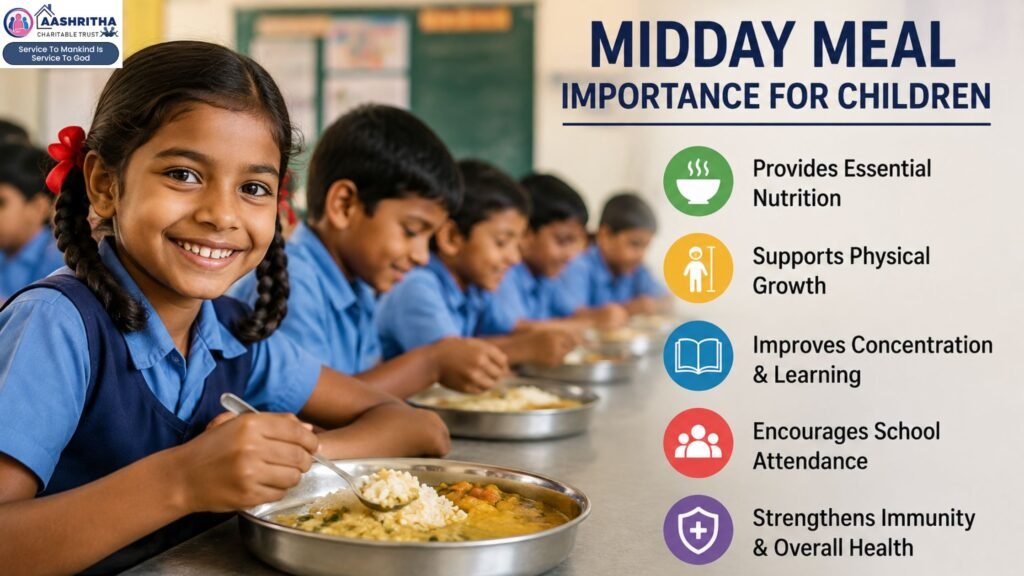
The midday meal importance for children can be understood by looking at several connected areas: nutrition, education, health, attendance, equality, and long-term development.
1. It Helps Fight Classroom Hunger
Hunger can affect a child’s ability to concentrate. A student who is thinking about food may struggle to focus on lessons, complete assignments, or participate in classroom activities.
A nutritious midday meal provides an important source of energy during the school day. Instead of spending the afternoon struggling with hunger, children can return to their lessons with greater energy and attention.
Government guidance has long recognised that hunger can reduce children’s ability to learn and participate effectively in school activities.
2. It Supports Physical Growth
Childhood is a crucial period for physical development. Children need adequate energy, protein, vitamins, minerals, and other nutrients for healthy growth.
A balanced school meal can complement food received at home, particularly for children whose families face financial difficulties. Pulses, vegetables, grains, and fortified ingredients can contribute to a child’s nutritional intake.
For example, the PM POSHAN guidelines prescribe pulses as an important source of protein, while fortified salt and oil may help provide nutrients such as iron, iodine, vitamins A, and D.
3. It Can Improve School Attendance
Food insecurity can create significant barriers to education. When families struggle to provide regular meals, children may experience hunger, poor health, or pressure to help with household responsibilities.
School meals can provide an additional reason for children to attend school regularly while addressing an immediate nutritional need. India’s school meal programme specifically aims to encourage disadvantaged children to attend school more regularly.
Regular attendance, in turn, gives children more opportunities to learn, build relationships, and develop important skills.
4. It Supports Better Learning
Education and nutrition are closely connected. A hungry child may find it difficult to concentrate, while a child whose nutritional needs are better supported may be more prepared to engage with lessons.
The midday meal importance for children therefore extends beyond nutrition. By helping children remain attentive and energetic during school hours, meals can contribute to a more supportive learning environment.
A meal cannot solve every educational challenge, but it can remove one significant obstacle: hunger.
5. It Promotes Equality
One of the powerful aspects of school meals is that children from different economic backgrounds can sit together and share the same meal.
Government programme guidelines recognise the social value of children eating together, noting that school meals can foster equality and help reduce social barriers.
This is especially meaningful because a classroom should be a place where children are valued for their potential rather than judged by their family’s financial circumstances.
6. It Can Support Girls’ Education
Hunger and poverty can affect girls disproportionately in some communities. School meal programmes can provide an additional incentive for families to keep children, including girls, in school.
The government has recognised the potential of school meals to support female school attendance and help reduce gender disparities in education.
When a girl receives nutrition and education, the benefits can extend beyond childhood. Education can improve future employment opportunities, independence, confidence, and decision-making.
The Role of Nutrition in a Child’s Future
Good nutrition during childhood is not simply about today’s hunger. It can influence a child’s ability to grow, learn, stay healthy, and participate in society.
Consider two children with similar academic potential. One arrives at school after a nutritious breakfast and receives a balanced lunch. Another arrives hungry and has little food available until evening. Their circumstances may affect their energy, attention, participation, and overall school experience.
This is why the midday meal importance for children should be considered part of a larger child-development strategy.
Food support, education, healthcare, sanitation, and emotional wellbeing all work together. Supporting one area can strengthen the others.
Midday Meals in Vijayawada and Andhra Pradesh
Andhra Pradesh has a long history of implementing school meal programmes. Government documentation records the development of midday meal initiatives in the state and establishes nutritional and food norms for children.
In Andhra Pradesh, locally available and seasonal ingredients can also be incorporated into school menus while maintaining nutritional standards.
For communities in Vijayawada, supporting child nutrition can therefore become an important part of broader social welfare efforts. NGOs, donors, volunteers, schools, local communities, and companies can contribute in complementary ways.
Aashritha Charitable Trust, based in Vijayawada, identifies nutritious meal distribution, education support for underprivileged children, and food-related community initiatives among its areas of work.
How Donations Can Help Children
For many donors, the most important question is simple: How can my contribution make a difference?
A donation can support programmes that address basic needs such as food and education. Aashritha’s initiatives include providing fresh and nutritious food to people in need and supporting children from disadvantaged backgrounds with educational materials and assistance.
Donations can potentially help organisations:
- Provide nutritious meals to children and vulnerable families
- Support food distribution programmes
- Purchase essential groceries and ingredients
- Assist children’s education
- Organise community nutrition initiatives
- Support outreach activities
- Expand programmes to reach more disadvantaged communities
Even a modest contribution can become meaningful when many people participate.
Why CSR Partnerships Matter
Companies can play an important role in improving child nutrition through Corporate Social Responsibility (CSR) initiatives.
A CSR partnership can support meal programmes, food distribution drives, education initiatives, health activities, or broader child welfare projects. Instead of treating nutrition as a one-time campaign, companies can consider sustained partnerships that create measurable community impact.
For businesses in Vijayawada, Andhra Pradesh, supporting child nutrition through a credible nonprofit can align community investment with an essential social need.
Aashritha welcomes collaborations and partnerships with NGOs and companies seeking to combine resources and expertise for social objectives.
How Volunteers Can Contribute
Not every contribution needs to be financial. Volunteers can offer their time, skills, and energy.
Volunteers may help with:
- Meal distribution drives
- Community outreach
- Food donation campaigns
- Awareness activities
- Educational support
- Fundraising initiatives
- Event coordination
- Social media awareness campaigns
A few hours of volunteering can help an organisation reach more people and conduct programmes more effectively.
Frequently Asked Questions
1. What is the midday meal importance for children?
The midday meal importance for children lies in its ability to address hunger while supporting nutrition, energy, school attendance, concentration, learning, and social equality.
2. How does a midday meal help students learn?
A nutritious meal can provide energy during school hours and help reduce the distraction caused by hunger. Better nutrition can support children’s ability to concentrate and participate in classroom activities.
3. What nutrients should a child’s school meal contain?
A balanced meal should provide appropriate sources of carbohydrates, protein, vegetables, healthy fats, and essential micronutrients. PM POSHAN nutritional norms specify calorie and protein requirements according to the child’s educational stage.
4. Can midday meals improve school attendance?
School meals are designed partly to encourage children, particularly those from disadvantaged communities, to attend school more regularly.
5. Why is child nutrition important in Andhra Pradesh?
Good nutrition supports children’s growth, health, energy, and learning. In Andhra Pradesh, school meal programmes and community initiatives can complement efforts to improve educational and social outcomes.
6. How can I support children facing hunger in Vijayawada?
You can donate, volunteer, sponsor meals, support food distribution drives, or participate in community outreach programmes. Organisations such as Aashritha work on food distribution and child welfare initiatives in Vijayawada.
7. Can companies support midday meal programmes through CSR?
Yes. Companies can explore CSR partnerships that support nutrition, food distribution, education, and other child welfare initiatives. Aashritha invites organisations and companies to collaborate on social-impact activities.
Every Meal Can Be a Step Toward a Better Future
A child should not have to choose between learning and hunger.
A midday meal may appear simple: a plate of nutritious food served during the school day. Yet its impact can reach much further. It can give a child energy to learn, support healthy growth, encourage regular attendance, and create an environment where children from different backgrounds share an experience of equality.
The midday meal importance for children is ultimately about giving young people the foundation they need to build healthier and more confident futures.
In Vijayawada and across Andhra Pradesh, communities can contribute to this mission by supporting organisations working with vulnerable children and families. Aashritha Charitable Trust’s food distribution and education initiatives demonstrate how community participation can help address basic needs while creating opportunities for children.
Support Child Nutrition Today
You can be part of the solution. Donate to Aashritha, sponsor food-related initiatives, volunteer your time, or explore a CSR partnership to support children and vulnerable communities. Every contribution can help turn a meal into an opportunity for better health, better learning, and a brighter tomorrow.