Imagine a person in Vijayawada reaching the end of a difficult day with no certainty about where the next meal will come from. Now imagine a volunteer arriving with a fresh, nutritious meal. For that person, the food is not simply a donation—it is relief, dignity, and a reason to feel that someone cares.
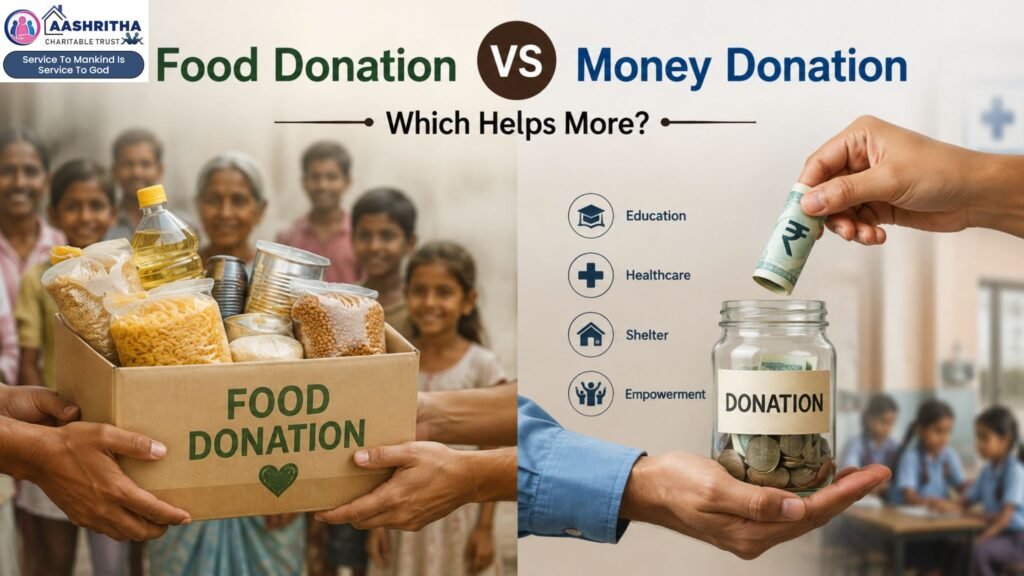
But this raises an important question for donors: food donation vs money donation – which helps more?
The answer is not always one or the other. Both forms of giving can create meaningful change when they are provided responsibly. Food can meet an immediate need, while money can help NGOs purchase food, organize distribution, support volunteers, and address other long-term community needs. In Vijayawada and across Andhra Pradesh, combining both approaches can make charitable efforts more effective.
At Aashritha, nutritious meal distribution is one of the community service initiatives focused on helping people facing hunger and vulnerability.
Why Food Donation Matters
Food is one of the most basic human needs. When someone is hungry, receiving food can provide immediate assistance in a way that few other forms of support can.
A plate of nutritious food can help a daily-wage worker get through the day, give an elderly person much-needed nourishment, or provide a vulnerable child with energy to learn and participate in school.
Food donation can also turn surplus resources into something useful. The Food and Agriculture Organization notes that 13.2% of food is lost in supply chains before retail, while a further 19% is wasted at retail, food-service and household levels according to 2024 UNEP statistics. Food loss and waste also contribute significantly to environmental impacts.
When safe surplus food can be properly recovered and redistributed, it can therefore serve two purposes: helping people facing food insecurity and reducing avoidable waste.
The Emotional Impact of a Meal
Think about the difference between telling someone, “We care about you,” and actually sitting beside them and serving a warm meal.
Food has a human connection.
Annadanam, the Indian tradition of sharing food with people in need, represents this idea beautifully. Aashritha’s hunger-relief initiatives in Vijayawada and Andhra Pradesh include food distribution, community meal programmes, senior support and volunteer-led food drives.
For many recipients, the value of a meal goes beyond calories. It can restore dignity and remind them that their community has not forgotten them.
Why Money Donation Matters
While food donation provides direct relief, money donation gives an NGO flexibility.
Suppose an organization receives 500 packets of rice but urgently needs vegetables, pulses, cooking oil or transportation to distribute meals. Physical donations may not always match the actual requirement.
Financial donations can allow a charitable organization to purchase what is needed at the right time.
Money can potentially support:
- Nutritious meal preparation
- Food ingredients and groceries
- Transportation and distribution
- Community outreach
- Volunteer programmes
- Educational support
- Senior care
- Emergency assistance
- Administrative and operational requirements
Aashritha states that funds from donors support its efforts to provide fresh and nutritious food to people in need.
This is why food donation vs money donation – which helps more? is better viewed as a question of purpose and circumstances rather than a competition between two types of generosity.
Food Donation vs Money Donation – Which Helps More?
The most practical answer is: the better donation is the one that meets a genuine need safely, efficiently and consistently.
Food Donation Can Be Better When:
Food donation may be particularly useful when:
- You have safe surplus food available.
- You want to sponsor or provide meals directly.
- You are organizing a community food drive.
- You want to support an Annadanam programme.
- You have nutritious packaged food suitable for distribution.
- You want to reduce safe, usable food waste.
However, donors should avoid giving spoiled, expired or unsuitable food. Food intended for donation should be safe, hygienic and appropriate for the recipients.
Money Donation Can Be Better When:
Financial support may be more useful when:
- An NGO needs flexibility to purchase supplies.
- You want your contribution to support regular meal programmes.
- You live outside Vijayawada or Andhra Pradesh.
- You cannot personally arrange food.
- You want to support multiple community programmes.
- An organization has identified a specific funding requirement.
For example, an individual living in Hyderabad, Bengaluru, Mumbai or outside India may find it easier to make a financial contribution to a trusted NGO working in Vijayawada rather than arranging physical food delivery.
Which Donation Creates More Long-Term Impact?
This depends on how the donation is used.
A single meal can solve an immediate problem: hunger today.
A financial contribution, when managed responsibly, can potentially help an organization plan regular meals, buy ingredients in appropriate quantities, coordinate volunteers and maintain distribution systems.
That means money can sometimes create scalable impact, while food can create immediate impact.
Neither should be dismissed.
Imagine a company in Andhra Pradesh wants to support hunger relief. Instead of simply donating leftover food once a year, it could partner with an NGO through a structured CSR programme, sponsor regular meal distribution and encourage employees to volunteer.
The result could be a combination of:
Funding + Food + Volunteers + Community Participation = Sustainable Social Impact
Food Donation vs Money Donation: A Simple Comparison
| Factor | Food Donation | Money Donation |
|---|---|---|
| Immediate hunger relief | Very high | High when converted into meals |
| Flexibility | Moderate | High |
| Helps reduce surplus food | Yes | Indirectly |
| Supports operational needs | Limited | Yes |
| Easy for people with surplus food | Yes | Not applicable |
| Suitable for long-term programmes | Sometimes | Often |
| Personal involvement | High | Can be lower |
| CSR opportunities | Yes | Yes |
| Best approach | Safe, useful food | Trusted NGO with clear needs |
The key is not simply how much you donate, but whether your donation reaches people who need it and contributes to a genuine social purpose.
How Donors in Vijayawada Can Make Food Donations More Effective
If you prefer food donation, consider making it organized rather than occasional.
You can:
- Sponsor nutritious meals instead of donating random food items.
- Coordinate with an NGO before bringing large quantities of food.
- Donate safe and hygienic food that can be distributed appropriately.
- Organize a community food drive with family, friends or colleagues.
- Support Annadanam programmes during meaningful occasions.
- Combine food and financial support when possible.
Aashritha’s existing food-related initiatives emphasize nutritious meals and community support in Vijayawada and Andhra Pradesh.
How Money Donations Can Create Greater Impact
Financial donors can also make their contributions more purposeful.
Instead of viewing a donation simply as an amount of money, ask:
What problem will this contribution help solve?
For example, your donation may help an NGO purchase ingredients for meal distribution. Another contribution may support education for an underprivileged child. A larger donor may support a recurring community programme.
Aashritha’s community initiatives extend beyond nutritious meal distribution to areas including senior care, education support and women’s upliftment.
This flexibility is one of the strongest arguments for financial donations.
The Role of CSR in Food and Hunger Relief
Businesses have an opportunity to make giving more structured through Corporate Social Responsibility (CSR).
A company can support hunger-relief programmes through:
- Sponsoring nutritious meals
- Funding food distribution drives
- Supporting Annadanam programmes
- Organizing employee volunteering
- Conducting food donation campaigns
- Partnering with NGOs for community initiatives
- Supporting long-term nutrition programmes
CSR does not have to be limited to writing a cheque. Employees can participate directly, helping create a stronger connection between the company and the community.
Aashritha has highlighted CSR-supported hunger-relief campaigns as one way businesses can participate in hunger elimination.
For companies operating in Vijayawada, Andhra Pradesh and surrounding areas, an NGO partnership can turn CSR budgets into visible community impact while supporting people facing food insecurity.
What About Donating Food on Special Occasions?
Birthdays, anniversaries, festivals and memorial occasions can become meaningful opportunities to give.
Instead of spending entirely on celebrations, families can choose to sponsor meals for people in need.
A meal donated in memory of a loved one can also become a lasting expression of compassion. Aashritha has described food donation in memory of loved ones as a way families can transform remembrance into support for vulnerable communities.
The emotional value can be profound: a personal occasion becomes an opportunity to bring happiness to someone else.
Can You Combine Food and Money Donations?
Absolutely.
In fact, for many donors, a combination may be the most practical approach.
For example:
Donate food: Sponsor meals or provide appropriate food supplies.
Donate money: Help cover ingredients, transportation and programme costs.
Donate time: Volunteer during meal preparation or distribution.
Donate expertise: Help an NGO with marketing, technology, fundraising, accounting or communications.
Donate through CSR: Encourage your company to create a structured community-support programme.
Giving is not restricted to money or food. Your time, skills and network can also become valuable resources.
FAQ: Food Donation vs Money Donation
1. Food donation vs money donation – which helps more?
Neither is universally better. Food donation can provide immediate nourishment, while money donations offer flexibility and can help NGOs purchase food and support distribution. The best option depends on the organization’s current needs.
2. Is donating food better than throwing surplus food away?
Yes, provided the food is safe, hygienic and suitable for consumption. Responsible redistribution of surplus food can help people facing food insecurity while reducing avoidable waste. FAO identifies recovery and redistribution of surplus food as a way to improve food use and address food insecurity.
3. Can I donate food in Vijayawada?
Yes. You can coordinate with a trusted NGO or charitable organization before donating. This helps ensure that the food matches actual community requirements and can be distributed safely.
4. Is money donation useful for hunger-relief programmes?
Yes. Financial donations can help organizations purchase ingredients, prepare meals, manage transportation and maintain regular programmes. They can also provide flexibility when needs change.
5. Can companies support food donation through CSR?
Yes. Companies can sponsor meals, fund food distribution programmes, encourage employee volunteering and establish longer-term NGO partnerships as part of suitable CSR initiatives.
6. What can students do to help people facing hunger?
Students can volunteer at food distribution drives, organize collection campaigns, raise awareness and encourage friends or educational institutions to participate in community-service activities.
7. Can I donate both food and money?
Yes. Combining the two can provide immediate assistance while also supporting the operational needs behind a charitable programme.
So, Which Should You Choose?
The debate over food donation vs money donation – which helps more? has no single answer.
If you have safe surplus food, donating it can turn excess into nourishment.
If you want flexibility and broader programme support, a financial donation may be more practical.
If you want deeper involvement, volunteer.
If you represent a company, consider a structured CSR partnership.
And if you can combine these forms of giving, your contribution can potentially become even more meaningful.
Across Vijayawada and Andhra Pradesh, hunger is not just a statistic. Behind every need is a person—a child who wants to learn, an elderly person who deserves dignity, a worker trying to provide for a family, or an individual simply hoping for one satisfying meal.
One meal may not change the entire world.
But for someone who is hungry, one meal can change that day.
And when thousands of people choose to give, those individual acts can become a powerful movement.
Make a Difference with Aashritha
Your contribution can help turn compassion into action.
Donate to support food and community welfare initiatives.
Volunteer your time and skills to support people in need.
Partner through CSR and create a structured social-impact programme for your organization.
Apply for an Internship to gain practical experience while contributing to meaningful community service.
If you are looking for a trusted way to support hunger-relief and community welfare initiatives in Vijayawada and Andhra Pradesh, explore Aashritha and discover how you can participate.
Donate. Volunteer. Partner through CSR. Start your Internship.
Together, we can make sure that compassion does not remain just a feeling—it becomes a meal, a helping hand, an opportunity and, ultimately, hope.