When floods strike, food becomes more than a basic necessity—it becomes a lifeline. Families may lose access to kitchens, grocery stores, clean water and transportation within hours. This is where humanitarian organisations step in. How NGOs distribute food during floods is a carefully coordinated process involving rapid assessment, food preparation, packaging, transportation, beneficiary identification and last-mile distribution.
In flood-affected regions such as Vijayawada and other parts of Andhra Pradesh, NGOs often work alongside volunteers, local communities, government agencies and donors to make sure food reaches people who need it most. The 2024 Vijayawada floods demonstrated how large-scale community participation can help provide meals and essential supplies during an emergency.
For families stranded in flooded neighbourhoods, a food packet can mean much more than a meal. It can represent safety, dignity, compassion and hope.
Why Food Distribution Becomes Critical During Floods
Flooding can disrupt almost every part of daily life. Roads become inaccessible, shops may remain closed, electricity can be interrupted and families may be forced to leave their homes with little or no food.
Children, senior citizens, pregnant women, people with disabilities and low-income families can be particularly vulnerable during such emergencies.
Government disaster-management guidance recognises the importance of providing food and essential commodities to people who have been evacuated or stranded during floods. Flood shelters and relief centres also require access to basic necessities such as food, drinking water and sanitation.
This is why understanding how NGOs distribute food during floods is important for both communities and potential donors. Effective food relief is not simply about cooking thousands of meals. It requires planning, logistics, hygiene, local knowledge and coordination.
How NGOs Distribute Food During Floods
Although every disaster response is different, NGOs generally follow a structured process to move food from kitchens, warehouses or suppliers to flood-affected families.
1. Assessing the Situation
The first step is understanding where the need is greatest.
NGO teams and volunteers may gather information from:
- Local residents
- Community leaders
- Government officials
- Relief camps
- Field volunteers
- Local organisations
- Rescue and emergency-response teams
Teams assess which areas are severely affected, how many people require food, whether roads are accessible and what type of food is practical to distribute.
This assessment helps prevent duplication and allows limited resources to be directed towards communities facing the greatest need.
In a major urban flood such as the Vijayawada floods, affected neighbourhoods can have very different requirements. Some families may be staying in relief camps, while others may remain stranded in homes or temporary shelters.
2. Identifying Beneficiaries
Once affected areas are identified, NGOs determine who needs assistance.
Beneficiary identification may consider factors such as:
- Families displaced from their homes
- People staying in relief shelters
- Households without cooking facilities
- Children and elderly people
- Persons with disabilities
- Families who have lost food stocks
- Communities in areas that remain inaccessible to markets
Good disaster response aims to make distribution fair and transparent.
International humanitarian organisations also emphasise beneficiary targeting, registration, monitoring and evaluation as important elements of relief distribution.
This is one of the most important parts of understanding how NGOs distribute food during floods. The goal is not simply to distribute the largest number of packets—it is to ensure that assistance reaches the people who genuinely need it.
3. Deciding Between Cooked Food and Dry Rations
The type of food distributed depends on the circumstances.
If families cannot cook because their homes are flooded, cooking fuel is unavailable or kitchen facilities have been damaged, NGOs may provide ready-to-eat meals or cooked food.
If families have returned home and can cook safely, dry ration kits may be more useful. These can contain items such as:
- Rice
- Dal
- Cooking oil
- Salt
- Sugar
- Spices
- Flour or wheat
- Other locally appropriate staples
Food assistance should consider local eating habits and nutritional needs. International disaster-response guidance also stresses that food should be safe, nutritious and appropriate for the affected community.
4. Procuring Food Locally
Large-scale food distribution requires significant quantities of ingredients.
NGOs may purchase supplies from local wholesalers, retailers, farmers, food suppliers or established vendors. Local procurement can have several advantages, including reduced transportation time, better familiarity with local dietary preferences and support for the local economy.
An IFRC flood operation in India, for example, documented local procurement because food items were perishable, locally available and better suited to local traditions, while also reducing transportation costs.
For flood relief in Andhra Pradesh, local procurement can therefore be an efficient part of emergency food operations when markets and transportation routes remain functional.
5. Preparing Meals in Community Kitchens
When cooked food is required, NGOs may establish or use community kitchens capable of preparing large quantities of meals.
Volunteers, professional cooks and support staff work together to:
- Purchase ingredients
- Clean and prepare food
- Cook meals
- Portion meals
- Pack food
- Load vehicles
- Transport meals to affected areas
Large-scale kitchens can significantly increase the speed of food production.
During the 2024 Vijayawada floods, the Hare Krishna Movement/Akshaya Patra reported providing meals on a very large scale, with its mechanised kitchen serving hundreds of thousands of flood victims during the emergency.
6. Maintaining Food Safety and Hygiene
Food relief must be safe as well as sufficient.
Flood environments can create serious sanitation challenges. Contaminated water, poor waste disposal and damaged infrastructure can increase health risks.
NGOs therefore need to pay attention to:
- Clean cooking areas
- Safe drinking water
- Proper food handling
- Clean utensils
- Hygienic packaging
- Safe transportation
- Appropriate storage
- Timely distribution
India’s flood-management guidance highlights safe food preparation, hygiene and the use of safe water as important measures following floods.
Food that reaches a family late or in unsafe condition cannot achieve the purpose of relief. This makes logistics and hygiene essential parts of how NGOs distribute food during floods.
7. Packing Food for Easy Distribution
Once prepared, meals are packed into containers or food packets.
Packaging needs to be practical because volunteers may have to carry hundreds or thousands of packets through difficult conditions.
A typical cooked-food packet might include a staple meal, vegetable preparation, dal, rice or another locally familiar combination.
Dry ration kits are generally packed according to household requirements and the availability of supplies.
The objective is simple: make the food easy to transport, distribute and consume.
8. Reaching Flood-Affected Locations
This can be one of the most difficult stages.
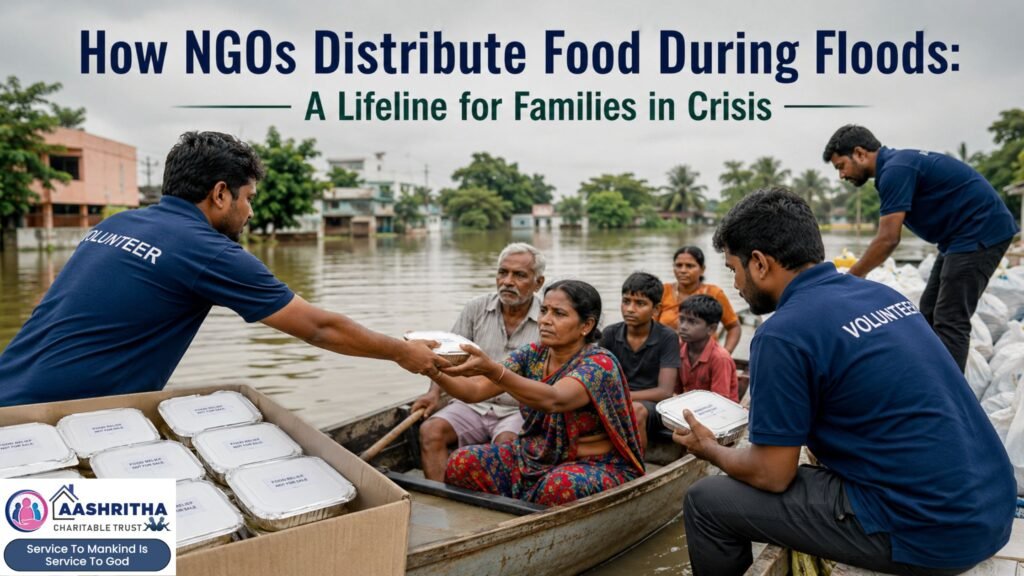
Floodwater may block roads and bridges. Vehicles may not be able to enter certain neighbourhoods. In some locations, volunteers may need to use boats or other available transportation methods.
Distribution teams may establish temporary collection points, relief camps or community distribution centres.
In Vijayawada, flood-relief organisations worked across affected neighbourhoods to provide food, drinking water, dry provisions and other essential supplies. Aashritha Charitable Trust, for example, reported distributing 10,000 food packets daily for one week during the September 2024 flood response.
These numbers illustrate the scale of coordination required when thousands of people suddenly need assistance.
9. Working With Local Volunteers
Volunteers are often the bridge between an NGO and the affected community.
A volunteer may help with:
- Packing food
- Loading vehicles
- Identifying affected families
- Managing queues
- Transporting supplies
- Distributing meals
- Recording beneficiaries
- Communicating local needs
Local volunteers can also help NGOs understand which streets, colonies and communities are most affected.
During the 2024 Vijayawada floods, several organisations mobilised volunteers to survey affected areas and distribute food and essential materials.
This human connection is a powerful part of how NGOs distribute food during floods.
10. Monitoring the Distribution
Relief work should not end when food leaves the kitchen.
NGOs may monitor:
- Number of meals prepared
- Number of packets distributed
- Locations covered
- Number of families assisted
- Remaining food stocks
- Transportation requirements
- Changing community needs
Monitoring helps organisations understand whether their response is effective and where additional support is required.
It also improves accountability to donors, volunteers and communities.
The Human Story Behind Every Food Packet
Imagine a family in Vijayawada waking up after a night of heavy rain.
Their kitchen is flooded. The refrigerator is no longer working. The nearby grocery shop is closed. There is no way to cook breakfast.
Then a volunteer arrives carrying a food packet.
It may contain a simple meal. But for that family, it means they do not have to worry about where their next meal will come from.
This is why how NGOs distribute food during floods is not merely a logistical question. It is about restoring a small sense of normality when everything around a family has changed.
The 2024 Vijayawada floods affected large numbers of people and required coordinated responses from government agencies, NGOs, volunteers and community groups. Aashritha’s reported relief response included food distribution as well as other essential assistance.
How Donations Support Flood Food Distribution
Large-scale relief operations require money even when volunteers provide their time.
Donations can help NGOs purchase:
- Rice and other staples
- Vegetables and cooking ingredients
- Drinking water
- Food containers
- Packaging materials
- Cooking fuel
- Transportation
- Hygiene supplies
- Dry ration kits
A small donation can contribute to a much larger relief operation when combined with contributions from many people.
For donors, it is also important to support organisations that communicate clearly about their work, maintain appropriate records and have experience working with communities.
How CSR Can Strengthen Flood Relief
Businesses can play an important role in disaster response through Corporate Social Responsibility (CSR).
CSR partnerships can support:
- Emergency food distribution
- Community kitchens
- Dry ration kits
- Drinking water
- Hygiene kits
- Transportation
- Disaster preparedness
- Community resilience programmes
For companies operating in Andhra Pradesh, supporting credible NGOs during emergencies can create meaningful community impact while contributing to their broader CSR objectives.
A well-planned CSR partnership can go beyond one-time donations. Companies can support disaster preparedness, volunteer programmes and long-term community recovery.
Why Supporting Local NGOs Matters
Local NGOs often have an important advantage during emergencies: they understand the communities they serve.
They may already have:
- Local volunteers
- Community relationships
- Knowledge of vulnerable neighbourhoods
- Existing distribution networks
- Local suppliers
- Experience with social programmes
This can allow them to respond quickly when a disaster occurs.
For people looking to contribute to flood relief in Vijayawada or Andhra Pradesh, supporting an organisation with established local connections can make a meaningful difference.
How You Can Help During a Flood
You do not need to be a disaster-response expert to help.
Donate
Financial contributions can help NGOs purchase food and essential supplies according to the most urgent requirements.
Volunteer
Volunteers can assist with packing, cooking, transportation, communication and distribution.
Support Through CSR
Companies can partner with NGOs to fund food distribution, community kitchens and longer-term disaster-recovery initiatives.
Apply for an Internship
Students and young professionals can gain practical experience in community development, fundraising, communications, operations and disaster-relief programmes through NGO internships.
Frequently Asked Questions
1. How do NGOs distribute food during floods?
NGOs generally assess affected areas, identify vulnerable families, procure food, prepare cooked meals or dry ration kits, package them and transport them to relief camps or affected communities. Volunteers often assist with last-mile distribution.
2. What food is usually distributed during floods?
Depending on local needs, NGOs may distribute cooked meals, rice, dal, vegetables, oil, flour, sugar, salt and other essential food items. The choice depends on whether families have access to kitchens and cooking facilities.
3. How can I donate for flood food distribution in Vijayawada?
You can donate through a credible NGO working in disaster relief. Before donating, check the organisation’s official website and understand how contributions are being used.
4. Can companies support flood relief through CSR?
Yes. Companies can support eligible NGO programmes through CSR initiatives, subject to applicable CSR rules and their internal policies. CSR support can fund food distribution, emergency supplies, community kitchens and disaster-recovery activities.
5. Can students volunteer for flood relief?
Yes. Students can support suitable NGO activities such as food packing, awareness campaigns, logistics assistance, fundraising and community outreach, depending on the organisation’s requirements.
6. Why is local food important during disaster relief?
Local food preferences make meals more acceptable to affected communities. Local procurement can also reduce transportation requirements and help organisations respond faster when supplies are available nearby.
Support Flood Relief With Aashritha Charitable Trust
Floods can take away homes, belongings and livelihoods in a matter of hours. But compassion can reach affected families just as quickly.
The story of how NGOs distribute food during floods is ultimately a story of people helping people. From donors contributing funds to volunteers packing meals, cooks preparing food and field teams delivering packets, every person has a role in emergency relief.
Aashritha Charitable Trust has been involved in community-focused initiatives in Vijayawada, including food distribution and flood-relief efforts. During the September 2024 Vijayawada floods, the organisation reported distributing 10,000 food packets daily for a week to affected communities.
If you want to make a difference, your support can help turn compassion into action.
Donate to support relief work. Volunteer your time. Explore CSR partnerships. Or enquire about internship opportunities with Aashritha Charitable Trust.
Learn more about Aashritha’s initiatives and ways to contribute through the Aashritha Charitable Trust official website.
One meal can ease hunger. One volunteer can reach a family. One donation can help keep relief moving. Together, we can help communities in Vijayawada and across Andhra Pradesh recover with dignity and hope.