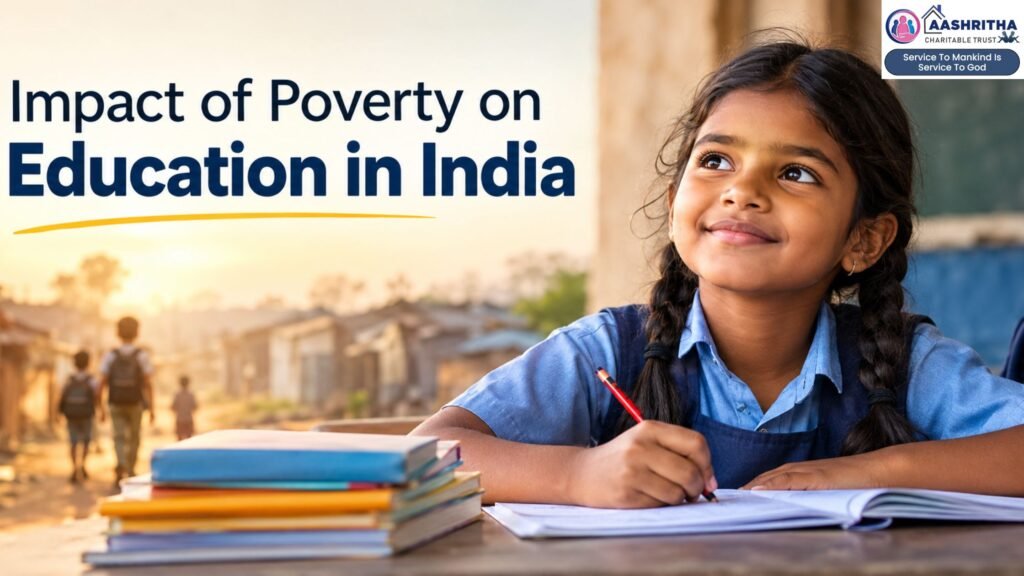
The impact of poverty on education in India is one of the most important social challenges affecting children and families across the country. Poverty can make it difficult for children to attend school regularly, afford learning materials, access digital resources, or continue their education beyond the basic level. While India has made significant progress in school enrollment, financial hardship continues to affect children’s ability to learn and complete their education.
Education can be one of the strongest pathways out of poverty. However, when families struggle to afford food, healthcare, transportation and other essentials, education may become a lower priority. This creates a cycle in which poverty limits educational opportunities, and limited education reduces future employment and income opportunities.
The good news is that individuals, NGOs, volunteers, communities and donors can all contribute to breaking this cycle.
What Is the Impact of Poverty on Education in India?
The impact of poverty on education in India goes beyond a child simply being unable to pay school fees. Financial hardship can affect almost every part of a child’s educational journey—from early childhood development and school attendance to learning outcomes, confidence and future career opportunities.
According to ASER 2024, school enrollment among children aged 6–14 in rural India remained very high at 98.1%. However, enrollment alone does not guarantee meaningful learning. ASER found that in 2024, only 27.1% of all Std III children in rural India could read a Std II-level text.
This highlights an important point: getting children into school is only the beginning. They also need the resources and support necessary to learn successfully.
How Poverty Affects Children’s Education
1. Lack of School Supplies
For a family living on a limited income, the cost of school bags, uniforms, books, notebooks, stationery and other materials can become a significant burden.
A child may technically be enrolled in school but still struggle because they do not have the basic materials required for classroom participation.
Providing educational kits can therefore be a simple but meaningful intervention. A school bag, notebooks, books, stationery and a uniform may appear small individually, but together they can remove practical barriers that discourage children from participating confidently in school.
2. Irregular School Attendance
Another major impact of poverty on education in India is irregular attendance.
When families experience financial difficulties, children may be expected to help with household responsibilities, care for younger siblings or contribute to family income. Long-term financial pressure can make regular attendance difficult.
UNICEF identifies poverty among the interconnected factors that can contribute to school dropout in India, alongside issues such as climate shocks, gender norms, poor educational performance, disability-related barriers and distance from school.
Missing school repeatedly can cause children to fall behind academically. Once a learning gap develops, catching up with classmates can become increasingly difficult.
3. Child Labour and Lost Learning Opportunities
In extremely poor households, children may be pushed toward work because the family needs additional income.
This creates one of the most serious consequences of the impact of poverty on education in India: a child may have to choose between immediate financial survival and long-term educational development.
Child labour can reduce school attendance, limit study time and increase the possibility of dropping out completely. Without adequate education, children may later find themselves restricted to low-paying or insecure employment, continuing the same cycle of poverty into adulthood.
4. Poor Nutrition Can Affect Learning
Education cannot be separated from a child’s basic health and nutrition.
A child who regularly experiences hunger may find it difficult to concentrate in class, participate in activities or complete homework. Poor nutrition can also affect physical development and overall well-being.
This is why effective child-development initiatives often need to consider education alongside nutrition, healthcare and family support.
Aashritha Charitable Trust also works on nutritious meal distribution, recognizing that children and disadvantaged communities need support with basic necessities as well as educational opportunities.
5. Limited Access to Digital Learning
Technology has become increasingly important in education. Students may need smartphones, computers or internet access for educational videos, online classes, research and digital learning resources.
However, families with limited incomes may not be able to afford devices or reliable internet connections.
The digital divide can therefore create another layer of inequality between children from financially secure households and children from disadvantaged families.
ASER 2024 also included digital access, usage and skills among 14–16-year-olds in rural India, reflecting the growing importance of digital readiness in education.
6. Parents May Struggle to Provide Academic Support
Parents generally want their children to succeed, but poverty can limit the time and resources available for educational support.
Parents working long hours may not have enough time to help with homework. Some may also have limited formal education themselves and therefore find it difficult to assist with advanced subjects.
This does not mean parents do not value education. Instead, it shows why community-based tutoring, mentoring and learning support can make a difference.
The Learning Gap: Why Enrollment Is Not Enough
India has made considerable progress in getting children into school. ASER 2024 reported that 98.1% of children aged 6–14 in rural India were enrolled in school.
But learning outcomes tell a more complicated story.
In 2024, 27.1% of Std III children in rural India could read a Std II-level text. For government schools, the figure was 23.4%, while private schools recorded 35.5%.
At the same time, ASER 2024 reported improvement in learning levels compared with 2022, particularly in government schools. This demonstrates that educational interventions can work when children receive the right support.
The lesson is clear: the solution to poverty-related educational inequality is not only school enrollment. Children also need learning materials, academic support, nutrition, mentoring, technology and encouragement.
Real-World Impact: What Educational Support Can Change
Consider a child from a financially disadvantaged household.
The child wants to attend school but lacks a school bag and basic stationery. Their parents are struggling to meet household expenses, so purchasing educational materials is difficult. The child starts missing classes and becomes increasingly hesitant to participate.
Now imagine that the child receives a school kit, educational materials, academic support and encouragement from a community organization.
The immediate financial pressure is reduced. The child can participate more confidently in class. Regular support can help the student remain engaged and gradually improve their learning.
This is why educational support should not be viewed simply as a donation of books or school supplies. It can be an investment in a child’s confidence, skills and future opportunities.
Aashritha Charitable Trust’s education initiatives include providing books, uniforms, bags and related educational materials to children from disadvantaged backgrounds.
How Poverty Creates a Cycle of Educational Inequality
The relationship between poverty and education can become a cycle:
Low household income → fewer educational resources → irregular attendance or poor learning → higher risk of dropout → limited skills → fewer employment opportunities → continued poverty
Breaking this cycle requires intervention at different stages.
A child may need a school bag today, academic support tomorrow and career guidance several years later. Sustainable educational support therefore needs to look beyond one-time assistance.
Scholarships, school supplies, tutoring, mentoring, digital learning and skill development can work together to create stronger outcomes.
How Donating to Education Can Make a Difference
One of the most direct ways to reduce the impact of poverty on education in India is to support organizations working with disadvantaged children.
Your donation can help contribute toward educational resources such as:
- Books and notebooks
- School bags
- Stationery
- School uniforms
- Tuition and academic support
- Scholarships
- Digital learning resources
- Skill-development activities
- Mentoring and guidance
Aashritha Charitable Trust specifically identifies education sponsorship as one of its community initiatives and aims to help children from poor backgrounds by providing educational materials and encouraging financial support for their education.
Sponsor a Child’s Education
Sponsoring education is more than paying for an expense. It means helping a child continue learning despite financial difficulties.
If you would like to contribute, visit Aashritha Charitable Trust to learn about education sponsorship and donation opportunities.
Support Aashritha’s Education Initiatives
How You Can Volunteer to Support Education
Donations are not the only way to help.
Volunteers can contribute their time, knowledge and professional skills. Depending on the organization’s current requirements, volunteers may support activities such as:
- Teaching or tutoring children
- Mentoring students
- Organizing educational activities
- Distributing school materials
- Supporting awareness campaigns
- Helping with fundraising
- Creating educational content
- Supporting digital learning
- Organizing community events
Aashritha invites people with relevant skills and an interest in community service to become volunteers.
If you have teaching, communication, digital marketing, technology, event management or other useful skills, your time can become a valuable contribution.
Why Supporting Girls’ Education Matters
Poverty can have a particularly serious effect on girls’ education when families face difficult financial circumstances.
Girls may be expected to take on household responsibilities or leave school earlier than planned. Ensuring that girls remain in education can help them develop knowledge, confidence and employment skills.
Supporting girls’ education therefore has benefits that can extend beyond one individual. An educated and financially independent woman can contribute to her family’s well-being and help create better opportunities for the next generation.
What Can NGOs Do to Reduce the Impact of Poverty on Education?
NGOs can act as a bridge between disadvantaged families and available educational opportunities.
Effective NGO programs may include:
- Education sponsorship – helping children meet school-related expenses.
- Learning materials – providing books, uniforms, bags and stationery.
- Academic support – offering tutoring and learning assistance.
- Skill development – helping older students develop practical skills.
- Mentoring – providing encouragement and guidance.
- Community awareness – educating families about the importance of continuing education.
- Partnerships – working with donors, volunteers and companies to expand impact.
Aashritha’s stated education initiatives include books, skill-development drives and assistance toward educational expenses for underprivileged children.
Frequently Asked Questions
1. What is the impact of poverty on education in India?
The impact of poverty on education in India includes difficulty affording school materials, irregular attendance, limited access to digital resources, poor learning support, child labour and increased risk of dropping out.
2. How does poverty affect children’s school attendance?
Financial hardship can force families to prioritize essential household expenses. In some situations, children may have to work, take care of siblings or perform household responsibilities, making regular school attendance difficult.
3. Does poverty affect learning outcomes?
Yes. Poverty can limit access to books, tutoring, technology, nutrition and supportive learning environments. These disadvantages can contribute to learning gaps.
4. How can I help a poor child’s education in India?
You can sponsor educational expenses, donate school supplies, volunteer as a tutor or mentor, support an education-focused NGO, or help raise awareness about educational inequality.
5. Can donating school supplies really help children?
Yes. School bags, books, notebooks, stationery and uniforms can remove practical barriers and help children participate more confidently in school.
6. How can I sponsor a child’s education through Aashritha?
You can visit the Aashritha website to learn about its education initiatives, donation options and opportunities to support children from disadvantaged backgrounds. Aashritha’s website highlights education sponsorship as one of its community service initiatives.
7. Can I volunteer to support children’s education?
Yes. Aashritha welcomes people interested in volunteering and community service. You can contact the organization through its website to learn about current volunteer opportunities.
Conclusion: Education Can Break the Cycle of Poverty
The impact of poverty on education in India is complex, but it is not impossible to address.
India has made substantial progress in school enrollment, yet many children still need additional support to learn, stay in school and prepare for their future. The challenge is therefore not only getting children into classrooms—it is ensuring that financial hardship does not prevent them from making the most of their education.
Every child deserves the opportunity to learn regardless of their family’s income.
A school bag can remove one barrier. A scholarship can keep a student in school. A volunteer can provide encouragement. A donation can provide educational resources. A sustained sponsorship can help a child continue their journey toward a better future.
You can be part of that change.
If you want to help reduce educational inequality and support children from disadvantaged backgrounds, consider donating, sponsoring education or volunteering your time with Aashritha Charitable Trust.
Donate or Learn More About Aashritha
Together, we can help ensure that poverty does not decide a child’s educational future.