A needle, a thread, and a sewing machine may look like simple tools, but for a woman seeking independence, they can represent something much bigger—a livelihood, confidence, dignity, and hope. Tailoring Training for Women can create practical opportunities for women to develop income-generating skills and become more self-reliant. At Aashritha Charitable Trust, our recent tailoring training initiative in Vijayawada reflects this vision by helping women turn their abilities into possibilities.
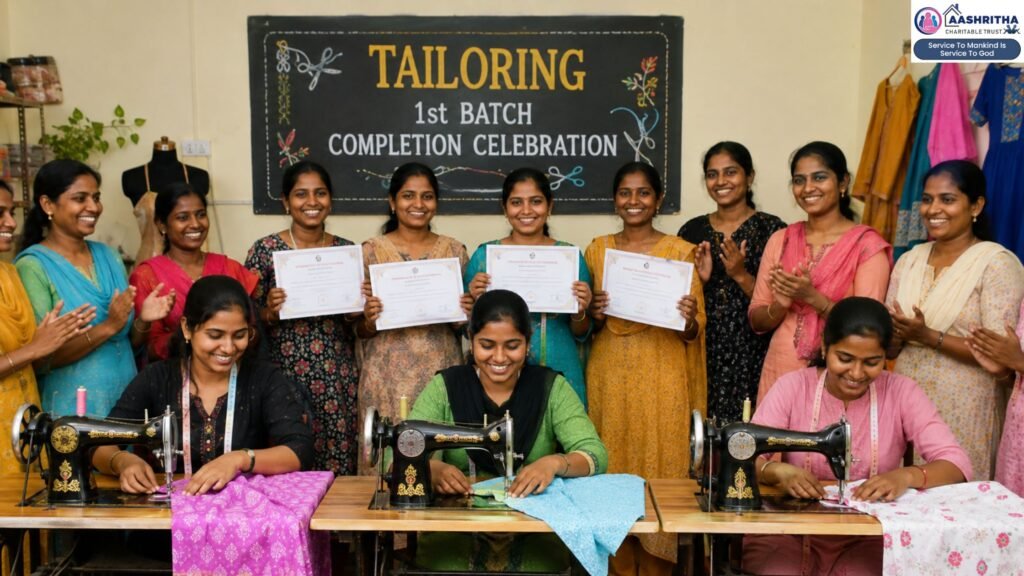
The completion of the first batch was not simply the end of a course. It was a celebration of confidence, determination, gratitude, and new beginnings. The students themselves organized the celebration as a heartfelt gesture of appreciation, making the occasion especially meaningful.
A Celebration That Meant More Than Completion
Every training programme has a beginning and an end. But for the women who participated in Aashritha’s first tailoring batch, completion represents the beginning of a new chapter.
The celebration was filled with smiles and emotion because the women could see the progress they had made. What started as an opportunity to learn a practical skill gradually became a journey towards confidence and self-reliance.
For many women, particularly those from economically disadvantaged backgrounds, earning an income can be difficult because of limited access to formal employment, education, mobility, or marketable skills. A home-based skill such as tailoring can offer a flexible pathway to livelihood generation.
This is why Women’s Tailoring Training is not merely about teaching someone how to operate a sewing machine. It is about creating an environment where women can learn, practise, gain confidence, and explore opportunities to earn.
Why Tailoring Skills Matter for Women
India has been seeing encouraging improvements in women’s participation in economic activity. According to the National Statistics Office’s Periodic Labour Force Survey, the female labour force participation rate for people aged 15 and above reached 40.0% in 2025 under the usual-status measure. The same report noted that women’s nominal wages increased across self-employment, regular wage/salaried employment, and casual labour between 2024 and 2025.
These figures demonstrate the importance of creating more pathways for women to participate in economic activity.
Skill development is one such pathway.
Tailoring is particularly useful because it can be adapted to different circumstances. A trained woman may work from home, accept individual stitching orders, provide alteration services, work with a boutique, or gradually establish a small tailoring enterprise.
For a mother who needs to remain close to her children, a home-based livelihood can be especially valuable. For a widow or woman facing financial hardship, a practical skill can become an important source of confidence and earning potential.
The objective is not simply to provide training. The larger goal is to help women move from dependency towards greater self-reliance.
Aashritha’s Commitment to Women’s Empowerment
Aashritha Charitable Trust, based in Vijayawada, Andhra Pradesh, was established in 2021 and works across several areas of community welfare, including elderly care, food distribution, education assistance, and women’s empowerment. Its women-focused initiatives include vocational training such as tailoring, beautician skills and computer education, along with financial literacy and livelihood support.
The Trust’s approach is rooted in the belief that sustainable change can begin with practical support at the grassroots level.
Aashritha’s Tailoring Training Program is designed around this principle. Instead of focusing only on short-term assistance, vocational training gives beneficiaries knowledge that they can continue using after the programme ends.
A sewing skill can remain valuable for years. With practice and determination, a woman can improve her craftsmanship, build a customer base, increase her income, and potentially train others in the future.
That is the multiplier effect of skill development.
From Learning to Livelihood
A successful training programme should go beyond theory. Participants need opportunities to practise what they learn and develop confidence in applying their skills.
Aashritha’s tailoring initiative focuses on practical learning, including areas such as fabric measurement, cutting, stitching techniques, finishing, and garment assembly. The Trust’s 2026 Vijayawada tailoring initiative was structured as a practical, market-oriented programme intended to help women pursue self-employment and home-based tailoring opportunities.
The training model can help participants understand the complete process of creating a garment rather than learning only individual stitching techniques.
This practical approach matters because confidence grows through practice.
A woman who initially hesitates to operate a sewing machine can gradually learn to measure fabric, make cuts accurately, stitch garments, complete finishing work, and eventually accept an order from a customer.
That transformation—from uncertainty to confidence—is one of the most valuable outcomes of vocational training.
The Emotional Meaning Behind the First Batch
The most touching part of the first batch completion celebration was that the students themselves took the initiative to organize it.
Their gesture of gratitude represented more than appreciation for a training programme. It showed that the initiative had created an emotional connection between the learners and the people supporting their journey.
The smiles of the participants reflected something that numbers alone cannot capture.
Behind every completed training batch is an individual story.
One woman may be thinking about supporting her children. Another may want to contribute to household expenses. Someone else may dream of having her own tailoring business. Another participant may simply want the confidence to become financially independent.
Their circumstances may be different, but their aspirations can be remarkably similar.
They want an opportunity.
They want to be respected for what they can do.
And they want to build a better future.
Tailoring Training and Women’s Financial Independence
Financial independence does not always begin with a large business or a high-paying job. Sometimes, it begins with one practical skill and the confidence to use it.
For women in economically weaker communities, Tailoring Training for Women can open several possible livelihood routes:
- Home-based stitching services
- Clothing alterations
- Blouse and dress stitching
- School uniform stitching
- Boutique-related work
- Custom garment orders
- Small tailoring enterprises
- Freelance stitching assignments
- Further skill development and entrepreneurship
The ability to earn even a modest income can make a meaningful difference to a household.
It can help women contribute towards groceries, children’s education, healthcare, savings, or other family needs. More importantly, earning can strengthen a woman’s sense of agency and decision-making power.
This is why women’s vocational training should be viewed as an investment rather than simply a charitable activity.
Why Vijayawada and Andhra Pradesh Need More Skill-Based Initiatives
Vijayawada is an important urban centre in Andhra Pradesh, surrounded by communities with diverse economic backgrounds. While opportunities exist, access to those opportunities is not always equal.
Women from financially vulnerable families may face barriers that prevent them from accessing conventional employment. Flexible, locally accessible vocational programmes can help bridge some of these gaps.
Aashritha’s work in Vijayawada demonstrates how community-based initiatives can respond to local needs. The Trust has specifically developed women’s empowerment programmes involving vocational skills and livelihood support.
Expanding such programmes across Vijayawada and, where resources permit, to other communities in Andhra Pradesh can help more women gain practical skills.
The first batch is therefore not just an isolated achievement. It can serve as a foundation for future training batches and broader women’s empowerment initiatives.
The Role of CSR in Creating Sustainable Impact
Corporate Social Responsibility can play a major role in making skill development programmes sustainable.
Aashritha’s Vijayawada tailoring initiative has already demonstrated the potential of CSR partnerships. The programme launched with CSR support from Innopay Technologies, with the aim of providing practical livelihood skills to women from economically weaker backgrounds.
This type of partnership illustrates how companies can convert CSR funding into measurable community impact.
A company supporting a training batch can help provide:
- Training infrastructure
- Sewing machines and equipment
- Training materials
- Qualified trainers
- Learning resources
- Programme administration
- Support for deserving beneficiaries
- Opportunities for continued skill development
CSR partnerships can therefore help NGOs move from conducting occasional programmes to building structured, recurring initiatives.
For companies looking to support women’s empowerment, livelihood development, and community welfare, sponsoring a Tailoring Training Program can be a practical way to create social impact.
Every Training Batch Can Create a Ripple Effect
Imagine one woman completing her training and starting a small tailoring service from home.
She begins with a few customers.
Her work becomes known in her neighbourhood.
She earns an income.
She contributes to her family.
She becomes more confident.
Later, she may employ another woman.
That second woman develops her own skills.
The impact continues.
This is why vocational training can create a ripple effect that extends beyond the original beneficiary.
The sewing machine may belong to one person, but the economic and social impact can reach an entire family and community.
How Donors Can Help
Running a free or subsidised training programme requires continuous resources. Training equipment, materials, instructors, infrastructure, maintenance, and programme coordination all involve costs.
This is where individual donors, philanthropists, CSR teams, and community supporters can make a difference.
A donation to Aashritha can help support initiatives designed to give women access to practical skills and livelihood opportunities.
Rather than providing only temporary relief, your contribution can help create an opportunity that beneficiaries can continue using long after the training programme is completed.
A small contribution can support training materials.
A larger contribution can help sponsor a training batch.
Corporate support can help expand the programme.
Together, these contributions can make it possible for more women to learn, practise, and pursue financial independence.
The Journey Continues After the Celebration
The first batch completion celebration is a moment to be proud of, but the real success will be measured by what happens next.
Will the women use their skills to earn?
Will they become more confident?
Will they support their families?
Will some start their own businesses?
Will future batches get the same opportunity?
These are the questions that make continued support important.
Aashritha Charitable Trust aims to continue developing grassroots initiatives that support women, vulnerable families, children, and senior citizens. Its work in Vijayawada reflects a broader commitment to creating sustainable solutions rather than relying only on short-term assistance.
Frequently Asked Questions
1. What is Tailoring Training for Women?
Tailoring Training for Women is a vocational skill development initiative designed to teach women practical garment-making and stitching skills that can support self-employment, home-based work, or other livelihood opportunities.
2. Who can benefit from a women’s tailoring training programme?
Women from economically disadvantaged backgrounds, widows, single mothers, women seeking livelihood opportunities, and others who want to develop practical income-generating skills can benefit from such programmes, subject to the eligibility criteria of the organisation conducting the training.
3. Why is tailoring useful as a livelihood skill?
Tailoring can be performed from home or through a small business setup. Women can potentially earn through stitching, alterations, custom orders, uniforms, and other garment-related services.
4. Where does Aashritha conduct its women’s empowerment initiatives?
Aashritha Charitable Trust is based in Vijayawada, Andhra Pradesh, and its women’s empowerment initiatives include vocational training such as tailoring, beautician skills, and computer literacy.
5. How can companies support tailoring training through CSR?
Companies can support a Tailoring Training Program by sponsoring training batches, equipment, materials, infrastructure, trainers, or other programme requirements. CSR partnerships can help expand the number of women receiving free or subsidised training.
6. Can individuals donate to support women’s skill development?
Yes. Individuals and philanthropists can contribute towards Aashritha’s charitable initiatives. Donations can help organisations continue programmes that support vulnerable communities and women’s livelihood development. Aashritha recommends using its official website for donations and transparency.
7. How can I volunteer with Aashritha?
People who want to contribute their time, professional skills, or community support can connect with Aashritha through its official website and contact channels to explore suitable volunteering opportunities.
Stitching a Better Future, One Woman at a Time
The completion of Aashritha’s first tailoring batch is a reminder that meaningful change often begins with something simple: an opportunity to learn.
A sewing machine can become a tool for income. A training class can become a pathway to confidence. A skill can become a livelihood. And one empowered woman can contribute to the strength and stability of an entire family.
The journey that began with the first batch in Vijayawada can inspire many more women across Andhra Pradesh to believe in their abilities and pursue greater independence.
Donate to support women’s skill development, volunteer your time and expertise, partner with Aashritha through CSR, or explore internship opportunities to contribute to community-based empowerment initiatives. Sponsor a training batch, empower a woman, and help transform a family’s future. Together, let’s stitch dreams into opportunities and build brighter futures—one woman at a time.