Why feeding the hungry is the greatest charity is a question that goes beyond money, religion, or social recognition. Food is one of the most basic human needs, and when someone is hungry, providing a nutritious meal can offer immediate relief, dignity, and hope. From a child going to school without breakfast to an elderly person struggling to afford a daily meal, hunger affects people in ways that are often invisible to society.
In Vijayawada and across Andhra Pradesh, individuals, NGOs, businesses, and communities can play an important role in addressing food insecurity. A meal may appear to be a small act, but for someone who has not eaten, it can make an enormous difference.
What Does It Mean to Feed the Hungry?
Feeding the hungry means providing people with access to sufficient, safe, and nutritious food when they cannot reliably obtain it themselves. It can include serving cooked meals, distributing groceries, supporting community kitchens, providing nutrition to children, or contributing financially to organizations working on food assistance.
Hunger is also broader than simply feeling hungry. According to the Food and Agriculture Organization (FAO), food insecurity occurs when people lack regular access to enough safe and nutritious food for normal growth, development, and an active and healthy life. Severe food insecurity can involve running out of food or going without eating for a day or more.
This is why feeding the hungry can be such a direct form of charity: it addresses an immediate and fundamental human need.
Why Feeding the Hungry Is the Greatest Charity
The idea behind why feeding the hungry is the greatest charity comes from the immediate impact of food assistance. When someone is hungry, they do not need a complicated solution in that moment. They need food.
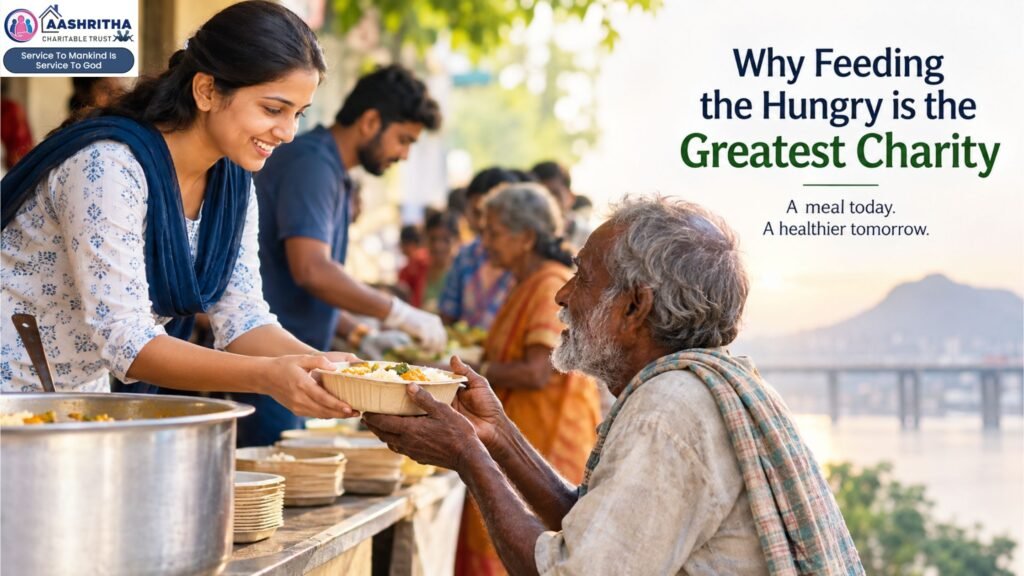
Imagine an elderly man sitting near a busy street in Vijayawada. He has spent the day asking for help but has received very little. As evening approaches, a volunteer arrives with a freshly prepared meal. The food does more than satisfy his hunger. It communicates that someone noticed him, cared about his situation, and was willing to help.
That simple interaction represents the human value of food charity.
1. Food Meets a Basic Human Need
People can postpone many things, but hunger cannot always be postponed. Food provides the energy required for daily activities, work, learning, and basic health.
The FAO notes that hunger is associated with insufficient access to dietary energy over time, while food insecurity can also involve uncertainty about obtaining adequate food.
Therefore, a food donation can have an immediate and tangible purpose.
2. A Meal Can Restore Dignity
Charity is not only about giving something away. It is also about how people are treated.
Serving a nutritious meal respectfully can help someone feel valued rather than forgotten. Food distribution programs that prioritize dignity, cleanliness, nutrition, and respectful interaction can make charitable support more meaningful.
In cities such as Vijayawada, where different communities live and work alongside one another, food donation initiatives can also bring people together around a shared humanitarian goal.
3. Feeding Children Can Support Education
A hungry child may struggle to concentrate, participate, or remain attentive in school. Access to nutritious food is therefore connected with a child’s broader development.
When communities support meals for children, they are not simply providing food for one day. They are contributing to an environment in which children have a better opportunity to learn, grow, and participate.
This is one reason food-focused charity can have effects that extend beyond the meal itself.
4. It Can Help Elderly and Vulnerable People
Older adults living alone, people experiencing homelessness, low-income families, and individuals facing temporary financial difficulties may all experience food insecurity.
A regular meal program can provide an important layer of support for people who may otherwise struggle to meet their daily food needs.
For NGOs and community organizations in Andhra Pradesh, identifying vulnerable groups and developing sustainable meal programs can help ensure that assistance reaches people who need it most.
The Global Reality of Hunger
Hunger remains a major global challenge. FAO’s latest data estimates that around 645 million people experienced hunger globally in 2025, equivalent to about 7.8% of the world’s population. The organization also emphasizes that progress toward ending hunger requires continued action and investment.
At the same time, hunger should not be understood only through global numbers. Behind every statistic is an individual, family, or community.
A person missing dinner is not a statistic to that person. It is an empty plate.
That perspective explains why why feeding the hungry is the greatest charity continues to resonate with donors and volunteers. Food assistance converts compassion into something tangible.
Feeding the Hungry in Vijayawada and Andhra Pradesh
Vijayawada is an important urban center in Andhra Pradesh, with people from different economic and social backgrounds. Like other growing cities, it has communities that may require different forms of social support.
Local food charity can take several forms:
- Providing cooked meals to vulnerable people
- Supporting food programs for children
- Donating groceries to families in need
- Organizing community meal drives
- Supporting elderly-care institutions
- Contributing to NGO food distribution programs
- Encouraging restaurants and businesses to responsibly redirect suitable surplus food
- Organizing corporate food donation initiatives
Local action has a major advantage: donors and volunteers can understand the needs of their own communities and participate directly.
Organizations such as Aashritha can help create opportunities for people who want to turn their concern about hunger into practical social action.
Food Charity Is About More Than Giving Money
Financial donations are valuable, but charity does not always have to begin with money.
Someone can volunteer their time. Another person can help organize a food drive. A business can support meals through its CSR program. A student can volunteer during weekends or holidays. A restaurant or food business may explore responsible ways to support community food programs.
The important point is consistency.
One meal can help one person today. A sustained program can support many people over weeks, months, and years.
How Your Donation Can Make a Difference
When you donate toward a food-related charitable initiative, your contribution can support activities such as:
Meal preparation: Ingredients and preparation costs can help provide cooked meals.
Food distribution: Volunteers and organizations need resources to transport and distribute food safely.
Nutrition: Donations can help organizations focus not only on quantity but also on nutritious and balanced meals.
Community programs: Regular funding can make it easier to plan recurring food-support initiatives.
Donors should always review an organization’s programs, transparency, donation process, and use of funds before contributing.
CSR: How Businesses Can Help Fight Hunger
Corporate Social Responsibility (CSR) can provide businesses with a structured way to support communities.
Companies in Vijayawada, Hyderabad, and across Andhra Pradesh can consider supporting food-related initiatives as part of their broader social-impact activities, subject to applicable CSR requirements and their approved CSR programs.
CSR support may include funding community meals, supporting nutrition initiatives, contributing to food distribution infrastructure, or partnering with experienced NGOs.
A company’s contribution can go beyond financial support. Employees can also participate in volunteering activities, food drives, and community outreach.
When businesses combine funding with employee engagement, food charity can become an ongoing community initiative rather than a one-time event.
Volunteer to Make a Direct Difference
Volunteering offers another meaningful way to support people experiencing hunger.
Volunteers can assist with:
- Food preparation
- Packing meals
- Distribution
- Community outreach
- Event coordination
- Donation campaigns
- Awareness activities
- Administrative and digital support
For people in Vijayawada and surrounding areas, volunteering with a trusted organization can provide an opportunity to understand local social needs firsthand.
Students can also explore volunteering opportunities that complement their education and develop skills such as teamwork, communication, coordination, and community engagement.
Internship Opportunities in the Social Sector
Students and young professionals interested in social impact can consider internships with NGOs and charitable organizations.
An NGO internship may involve social media, fundraising, content writing, event coordination, community outreach, research, administration, or volunteer management.
For students who want to build a career in the development sector, such experience can provide exposure to how social organizations operate and how community programs are planned and implemented.
If you are interested in contributing your skills while learning about social work, explore internship opportunities through organizations such as Aashritha.
Small Acts Can Become a Larger Movement
One person donating a meal may seem like a small action.
Ten people donating meals creates a larger effort.
A group of volunteers can organize distribution.
A company can provide CSR funding.
Students can contribute their time.
Local communities can create recurring food drives.
Together, these actions can build a culture in which helping someone who is hungry becomes a shared responsibility.
The most important lesson is that you do not have to wait until you can make a huge contribution. Start with what you can realistically give—time, money, food, skills, or awareness.
Frequently Asked Questions
1. Why feeding the hungry is the greatest charity?
Why feeding the hungry is the greatest charity is often explained by its direct impact. Food addresses an immediate and fundamental human need while also supporting dignity, wellbeing, and the ability to participate in everyday life.
2. How can I help feed hungry people in Vijayawada?
You can donate to a trusted NGO, volunteer for food distribution, organize a community food drive, or support a meal program operating in Vijayawada.
3. Can businesses support food charity through CSR?
Yes. Businesses can explore eligible food and nutrition initiatives within their CSR programs, subject to applicable laws, CSR rules, and their approved CSR activities.
4. Can students volunteer for food charity programs?
Yes. Students can volunteer for activities such as meal packing, distribution, event coordination, fundraising, content creation, and community outreach. They can also explore suitable NGO internship opportunities.
5. Is donating food better than donating money?
Both forms of support can be useful. Food donations can provide direct assistance, while financial donations can allow organizations to plan, purchase ingredients, manage logistics, and operate programs more consistently. The most appropriate option depends on the organization’s current needs.
6. How can I ensure my donation reaches people who need it?
Research the organization before donating. Review its website, programs, donation process, transparency information, and available impact reports. When possible, ask how donations are used and what type of support is currently needed.
7. Can I organize a food donation drive in Andhra Pradesh?
Yes. Individuals, schools, colleges, resident groups, and businesses can organize food drives in coordination with suitable organizations. It is important to plan food safety, storage, transportation, and distribution responsibly.
Conclusion: Turn Compassion Into Action
The answer to why feeding the hungry is the greatest charity can be found in something very simple: everyone deserves access to food.
A meal can provide relief when someone is hungry. Regular food support can provide stability. Nutrition can support children’s development. Community programs can give vulnerable people a sense that they have not been forgotten.
Across Vijayawada and Andhra Pradesh, every individual, student, volunteer, organization, and business can contribute in a meaningful way.
You can Donate to support food and community initiatives. You can Volunteer your time and skills. Your company can explore CSR opportunities to support sustainable hunger-relief programs. Students and young professionals can apply for an Internship and contribute their knowledge while gaining meaningful social-sector experience.
If you want to help create a community where fewer people have to face an empty plate, take the next step with Aashritha.
Donate. Volunteer. Support through CSR. Apply for an Internship.
Visit https://aashritha.org/ to learn more about how you can contribute to meaningful community initiatives and help turn compassion into action.