
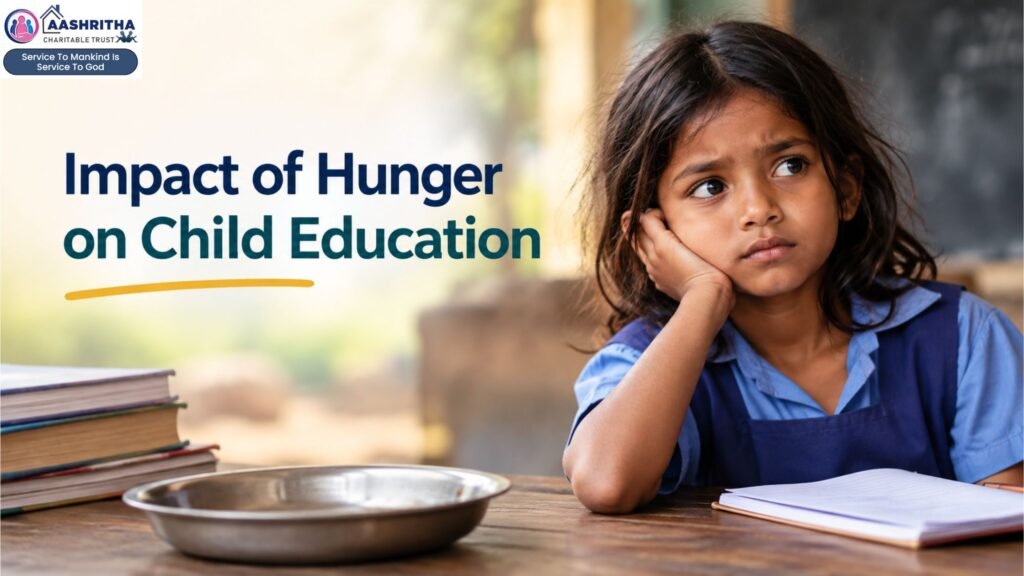
Imagine a child sitting in a classroom in Vijayawada, watching other students open their notebooks while quietly thinking about the last meal they had. The teacher begins a lesson, but concentrating becomes difficult. The child is tired, distracted and unable to participate fully—not because they lack ability, but because hunger is taking up their attention.
This is one of the most important ways to understand the impact of hunger on child education. Hunger does not only affect a child’s physical health. It can influence concentration, attendance, participation, learning outcomes and, over time, a child’s ability to remain in school.
Across India, children facing poverty and malnutrition can experience several overlapping disadvantages. UNICEF notes that children from poor and disadvantaged communities may face interconnected challenges involving malnutrition, school attendance, learning outcomes, sanitation and access to essential services.
For families in Vijayawada and across Andhra Pradesh, addressing children’s nutritional needs can therefore be an important part of creating an environment where children can learn, grow and pursue their aspirations.
What Is the Impact of Hunger on Child Education?
The impact of hunger on child education refers to the ways insufficient or inadequate food can interfere with a child’s ability to attend school regularly, concentrate in class, participate in learning and achieve age-appropriate educational outcomes.
A hungry child may struggle to focus on a mathematics problem, remember something taught earlier in the day or participate actively in classroom activities. Persistent undernutrition can have even longer-lasting consequences.
UNICEF explains that good nutrition supports children’s ability to grow, learn, play and participate in their communities. It also notes that stunting and undernutrition are associated with reduced learning capacity and poorer school performance.
This means education and nutrition should not be viewed as separate issues. A child needs both an opportunity to attend school and the physical and cognitive foundation required to benefit from that education.
1. Hunger Can Reduce Concentration in the Classroom
Learning requires sustained attention.
When a child is hungry, their immediate concern may be food rather than a lesson. They may become tired, restless or less engaged. Even when the child remains physically present in school, hunger can affect how effectively they participate.
For example, consider a student who arrives at school without breakfast. During the first few periods, the child may find it difficult to focus on reading, writing or mathematics. Instead of actively processing information, they may be thinking about when they will eat next.
Repeated experiences like this can create learning gaps over time.
This is why understanding the impact of hunger on child education is particularly important for teachers, parents, community organisations and NGOs working with vulnerable children.
2. Hunger Can Affect School Attendance
Hunger and poverty can influence whether a child is able to attend school consistently.
In households experiencing financial hardship, children may sometimes face competing responsibilities. They may help with household work, care for younger siblings or contribute to family income. Poor nutrition can add another layer of difficulty.
UNICEF identifies poverty, poor educational performance, family circumstances and other interconnected factors among the challenges associated with children leaving education systems.
Regular attendance matters because learning is cumulative. Missing lessons can make it harder for children to understand subsequent concepts, potentially creating a cycle in which falling behind makes school increasingly difficult.
3. Undernutrition Can Influence Learning Capacity
The consequences of hunger are not limited to the feeling of an empty stomach.
Long-term undernutrition during childhood can affect physical growth and development. UNICEF notes that stunting is associated with an underdeveloped brain, diminished mental ability and learning capacity, poorer school performance and reduced future earning potential.
This is particularly significant because early childhood is a critical period of development.
A child who receives adequate nutrition has a stronger foundation for healthy growth and development. A child experiencing prolonged nutritional deprivation may face challenges that extend beyond the classroom.
4. Hunger Can Affect Classroom Participation
Education is more than listening to a teacher.
Children learn through asking questions, reading, writing, solving problems, playing, collaborating and participating in classroom activities.
A child who is hungry or physically weak may be less likely to raise their hand, participate in group activities or engage with classmates. They may prefer to remain quiet because they are tired or uncomfortable.
Over time, reduced participation can affect confidence as well as academic engagement.
Creating supportive learning environments therefore requires attention to children’s broader wellbeing—not only textbooks and classrooms.
5. Poor Nutrition Can Contribute to a Cycle of Disadvantage
The relationship between hunger and education can become cyclical.
A simplified cycle can look like this:
Poverty → inadequate nutrition → reduced concentration/learning → weaker educational progress → fewer future opportunities → continued economic disadvantage
This does not mean every child experiencing hunger will have poor educational outcomes. Children are resilient, and many factors—including family support, school quality, healthcare and community assistance—can make a substantial difference.
However, addressing nutrition can remove one important barrier to learning.
UNICEF highlights that children facing poverty and disadvantage can experience multiple deprivations at the same time, including malnutrition, poor school attendance and low learning outcomes.
6. The Situation in Andhra Pradesh
The connection between nutrition and education is relevant across Andhra Pradesh, including communities in and around Vijayawada.
UNICEF’s Andhra Pradesh profile reports that the state has made significant progress in education, including near-universal primary enrolment and increased participation in upper-primary education. At the same time, it identifies continuing challenges around learning outcomes and child nutrition.
The same UNICEF profile, drawing on NFHS-5, reports that 16.1% of children under five in Andhra Pradesh were wasted and 6% were severely wasted. These figures concern young children rather than school-age children specifically, but they illustrate the broader nutritional challenges that can affect child development.
For organisations working in Vijayawada and other parts of Andhra Pradesh, this reinforces the value of combining educational support with nutrition and family-focused assistance.
7. School Meals Can Help Address Food Insecurity
School nutrition programmes can play an important role in supporting children.
India’s PM POSHAN programme is designed around providing meals to eligible schoolchildren, linking nutrition support with the school environment. Government and UNICEF initiatives also recognise the importance of connecting education, health and food systems.
A school meal does more than provide food for one day. For a child from a food-insecure household, it can provide reassurance that at least one nutritious meal is available during the school day.
However, school meals should be viewed as one component of a broader approach that includes household food security, healthcare, sanitation, clean water, nutrition education and educational support.
8. Why Nutrition and Education Must Be Addressed Together
Imagine investing heavily in a child’s education while ignoring whether that child has enough nutritious food to concentrate.
Education creates opportunities, but children need the health and nutritional foundation to take advantage of those opportunities.
UNICEF describes good nutrition as a foundation for children’s survival and development and emphasises that well-nourished children are better positioned to learn, play and participate in their communities.
This is why NGOs, schools, community organisations and responsible businesses can consider integrated programmes that combine:
- Nutritious food support
- Educational assistance
- School supplies
- Healthcare referrals
- Nutrition awareness
- Family support
- Child protection
- Skill development for older children
Such an approach recognises the child as a whole person rather than treating hunger and education as isolated problems.
9. How Communities Can Help Children Facing Hunger
Solving child hunger is not the responsibility of one organisation alone.
Individuals, NGOs, schools, businesses and local communities can contribute in different ways.
Donate
Financial contributions can help organisations provide food, education materials and other forms of support to children and families facing hardship.
Even a modest recurring contribution can become meaningful when many people participate.
Volunteer
Volunteers can support educational activities, mentoring, awareness programmes, community outreach and fundraising initiatives.
If you are based in Vijayawada or elsewhere in Andhra Pradesh, volunteering locally can be a practical way to understand community needs and contribute your time.
Support Through CSR
Companies can consider child nutrition and education as part of their Corporate Social Responsibility initiatives.
CSR partnerships can potentially support programmes such as:
- School nutrition initiatives
- Educational sponsorship
- Learning centres
- School supplies
- Digital learning resources
- Community nutrition programmes
- Scholarships
- Skill development
Companies interested in creating measurable social impact can work with credible NGOs to identify community needs, define programme objectives and monitor outcomes.
Consider an Internship
Students and young professionals can contribute through internships involving education, social work, fundraising, communications, research, community outreach and programme support.
An internship with a social-impact organisation can also provide practical exposure to how community programmes operate.
10. What Parents and Teachers Can Do
Parents and teachers are often the first people to notice changes in a child’s behaviour.
Warning signs may include persistent tiredness, reduced participation, difficulty concentrating, frequent absence or changes in classroom engagement. These signs should not automatically be attributed to hunger because many different factors can affect children’s behaviour and learning.
Schools and community organisations can help by creating supportive environments where families can discuss difficulties without stigma.
Teachers can also coordinate with appropriate school or community support systems when a child appears to need nutritional, educational or social assistance.
11. The Role of NGOs in Breaking the Cycle
NGOs can act as a bridge between vulnerable families, schools, donors, volunteers and wider community resources.
Organisations such as Aashritha can contribute to social development by supporting children and communities through programmes focused on education, care, awareness and assistance.
The goal is not simply to provide a meal or educational material once. Sustainable impact requires understanding the reasons behind vulnerability and building pathways toward long-term wellbeing.
For a child, that could mean having access to food today, staying in school tomorrow and eventually developing the skills needed for an independent future.
A Future Where Hunger Does Not Decide a Child’s Education
The impact of hunger on child education can be seen in many interconnected ways—from concentration and classroom participation to attendance, learning capacity and long-term educational opportunities.
India has made substantial progress in education and child development, but nutritional and educational challenges continue to overlap for disadvantaged communities. UNICEF’s data on India and Andhra Pradesh demonstrates why nutrition, health and education need to be considered together.
In Vijayawada and across Andhra Pradesh, communities can contribute by supporting initiatives that help children access nutritious food, remain engaged with education and develop the confidence and skills they need for the future.
A child should not have to choose between learning and eating.
Frequently Asked Questions
1. What is the impact of hunger on child education?
The impact of hunger on child education can include difficulty concentrating, reduced classroom participation, irregular attendance and poorer learning outcomes. Long-term undernutrition can also affect development and learning capacity.
2. Can hunger affect a child’s concentration in school?
Yes. Hunger can make it harder for children to maintain attention and actively participate in classroom activities. Persistent undernutrition can have broader effects on development and learning.
3. How does malnutrition affect education?
Malnutrition can affect physical and cognitive development. UNICEF reports that stunting is associated with reduced learning capacity and poorer school performance.
4. Why are school meals important for children’s education?
School meals can provide children with food during the school day while supporting broader nutrition and education goals. India’s PM POSHAN programme is one example of a government school-meal initiative.
5. How can I help children affected by hunger in Vijayawada?
You can consider donating, volunteering, supporting educational programmes, participating in community initiatives or exploring CSR partnerships with organisations working with children and vulnerable families.
6. Can companies support child nutrition and education through CSR?
Yes. Companies can explore CSR partnerships supporting areas such as nutrition, education, learning resources, scholarships, community programmes and child development, subject to applicable CSR rules and organisational priorities.
7. How can students contribute to child welfare?
Students can volunteer, undertake internships, organise awareness campaigns, support fundraising activities, tutor children or contribute professional skills such as design, content, technology and research.
Take Action: Help a Child Learn, Grow and Dream
The solution to child hunger is not only about putting food on a plate. It is about protecting a child’s opportunity to learn, develop confidence and build a better future.
If you believe every child deserves access to both nutrition and education, you can become part of that change.
Donate to support children and families in need.
Volunteer your time and skills to community initiatives.
Partner through CSR to support sustainable nutrition and education programmes.
Apply for an internship and gain practical experience while contributing to social impact.
Visit Aashritha at https://aashritha.org/ to learn more about opportunities to support children and communities.
One donation can provide support today. One volunteer can create encouragement. One CSR partnership can help build a sustainable programme. Together, these actions can help ensure that hunger does not stand between a child and education.